<?xml version="1.0" encoding="utf-8"?><feed xmlns="http://www.w3.org/2005/Atom" ><generator uri="https://jekyllrb.com/" version="3.10.0">Jekyll</generator><link href="dev.jezhou.com/feed.xml" rel="self" type="application/atom+xml" /><link href="dev.jezhou.com/" rel="alternate" type="text/html" /><updated>2026-10-01T17:46:54+00:00</updated><id>dev.jezhou.com/feed.xml</id><title type="html">jezhou</title><subtitle>A blog dedicated to my adventures in life, coding, and startups. &lt;a href=&quot;/about&quot;&gt;Who am I?&lt;/a&gt;</subtitle><author><name>Jesse Zhou</name></author><entry><title type="html">My time away from tech (2026)</title><link href="dev.jezhou.com/2026/09/28/My-time-away-from-tech.html" rel="alternate" type="text/html" title="My time away from tech (2026)" /><published>2026-09-28T00:00:00+00:00</published><updated>2026-09-28T00:00:00+00:00</updated><id>dev.jezhou.com/2026/09/28/My-time-away-from-tech</id><content type="html" xml:base="dev.jezhou.com/2026/09/28/My-time-away-from-tech.html"><![CDATA[<p>In December 2025, my wife and I decided it would be good for me to take a career break and focus a little more on myself. The stress of working at an early-stage startup since 2021 really took a toll on me, and I felt super burned out in the months leading up to my decision. We did some financial number-crunching and found that we could both afford not to work for up to a year. We decided to bite the bullet and commit.</p>

<p>Those 9 months away from work were transformative. I took a solo trip to climb Kilimanjaro. I traveled to China for a few months to see my family. And I finally got to try lots of different side projects that were on my plate. I finally got the freedom to really focus on myself!</p>

<p><img src="/images/2026-09-27-My-time-away-from-tech/IMG_3254.JPG" alt="IMG_3254" /></p>

<p>I gained a lot of perspective during this time and made a few realizations. Here are the big thoughts below.</p>

<h2 id="on-ai-advancements">On AI Advancements</h2>

<p>When I left work in December, Opus 4.6 just came out. I was very impressed with its capabilities, and wondered how much further AI would advance by the time I decided to return to the industry. Funny enough, within the first month of my break, OpenClaw came out and shook the tech industry to its core. Suddenly, coding agents weren’t enough, and people were saying their OpenClaw agents were the next big thing you couldn’t miss out on. I remember thinking, “Did I make a big mistake?”</p>

<p>Months went by. More models came out. OpenClaw peaked and then declined in popularity. Codex was shown in the Super Bowl commercials. Opus became the old coolness, Fable became the new one.</p>

<p>By the time I started my new job around two weeks ago, I got back up to speed rather quickly: I fired up Claude Code again and went back to work. Yes, I was very impressed with Fable for a few of my first tasks, and I set up Claude-in-Chrome and tried a few new skills. After such a long time away, I picked up back where I left off in pretty much no time.</p>

<p>My point with all of this is that a lot of the innovations in AI these days are noise, and sometimes you don’t know it’s noise until it’s a good distance behind you. I think a lot of people who are deep in the AI bubble feel overwhelmed about every major “innovation,” but the truth is, time is the ultimate test of utility.</p>

<p>I think certain tools (like Claude Code, Codex, and Cursor) are here to stay, but everything else was just a shiny, cool thing that ultimately distracted from the real work engineers need to do.</p>

<p>Also, I think it’s under-appreciated how much inertia there is when it comes to AI tooling in this economy. I live in Philadelphia, and if you’re not actively working in tech and are just out and about every day, people rarely talk about AI and agents the way they do on HackerNews.</p>

<h2 id="on-the-nature-of-work">On the nature of work</h2>

<p>At the height of my burnout, I would daydream about traveling a lot. There’s a sense of freedom you only get by traveling, and part of the appeal is just being away from the problems that cause you so much stress.</p>

<p>However, when you’re not working and you’re traveling, you’re keenly aware of how much money you’re spending every day. You suddenly take your budgeting tools much more seriously and are aware of how much money you really need to be happy. I think that, around month six, my relationship with money started to become less toxic. I used to have a very title- and money-driven personality. But being away from the thing that gave you a title and money made me realize what was actually important to me when I did not have them: slowing down, having some time for myself, and the people around me.</p>

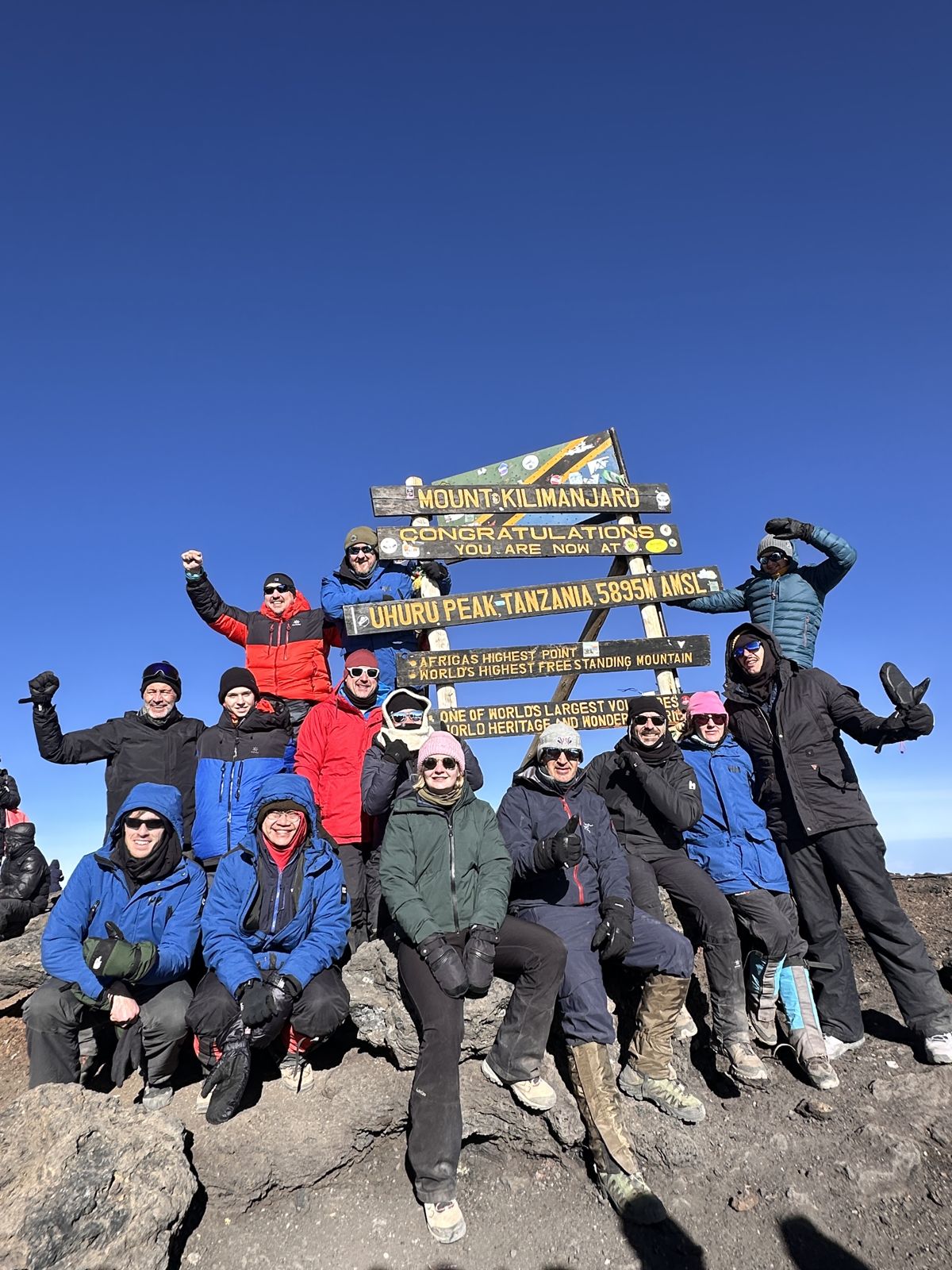
<p>When I climbed Mt. Kilimanjaro, I met two brothers from France. One of them told me something that’s hardened into a principle: if your personal, family, and work lives are all balanced, you will be a very happy person. I reflected on that and realized how much work had consumed me while I was in San Francisco, and that I was very much out of balance. Moving forward, I vowed to set good boundaries and make sure each slice of my life had a fair share.</p>

<p><img src="/images/2026-09-27-My-time-away-from-tech/IMG_3306.JPG" alt="IMG_3306" /></p>

<center>
  <small>
    <p>
			On top of the roof of Africa with my group. They are incredible people.
  </p>
  </small>
</center>

<p>At the same time, towards the middle of my break, I started to get bored. <a href="https://lingodex.app/">I started coding up an app on my own</a>, which was hard, and didn’t get much traction. It wasn’t hard because of the coding (especially with AI tools). It was hard because of all of the non-coding things that I didn’t have any experience in, like marketing.</p>

<p>That’s when the horrible truth hit me: it’s much easier to find and get a job than it is to start your own venture. And I realized that a balanced kind of life is the opposite of a founder’s life. Lots of people on entrepreneurial subreddits say that they didn’t know they would be working <em>more</em> after quitting their job to pursue their passion. During my time creating my app, I felt this deeply in my bones.</p>

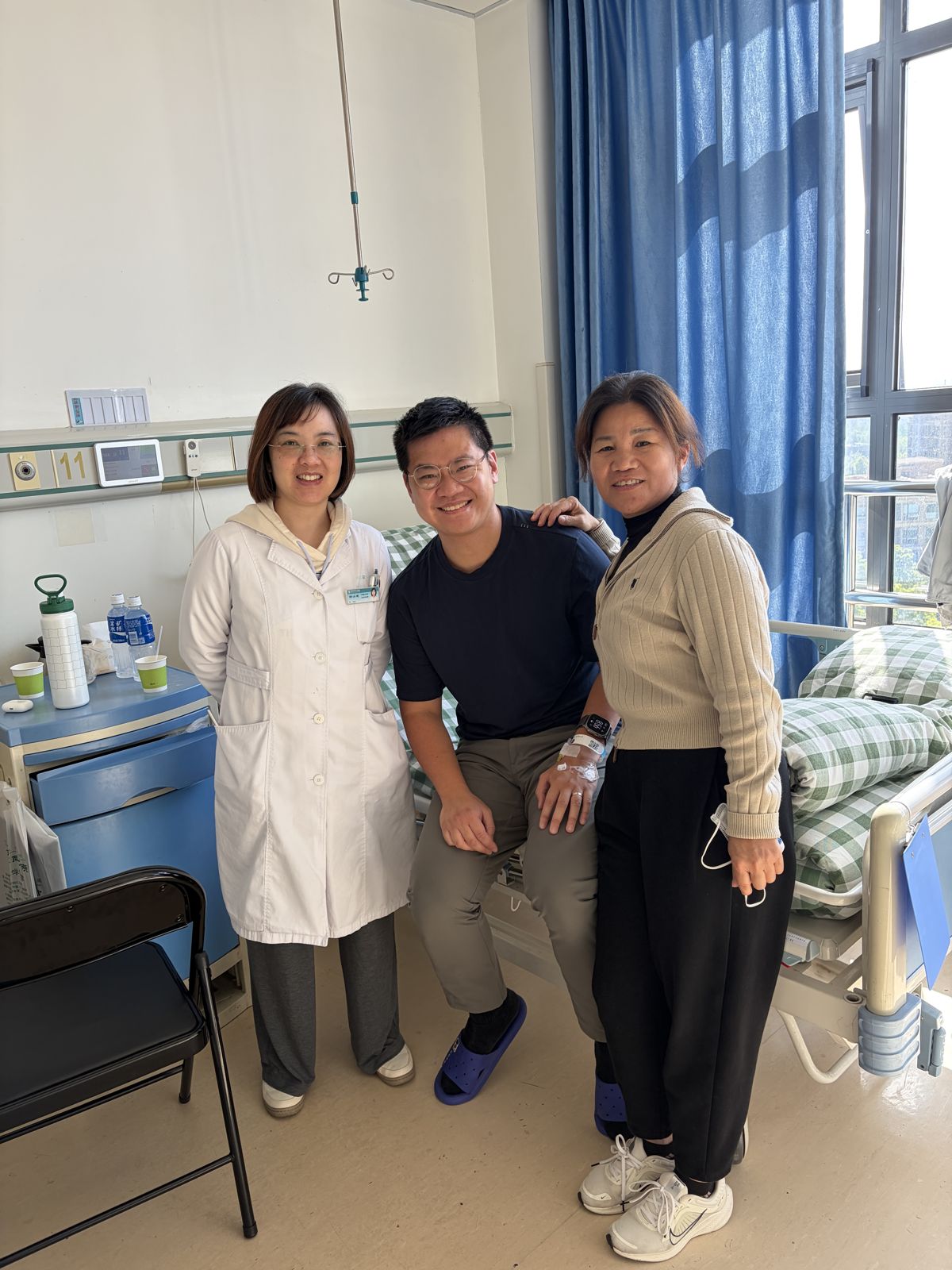
<p>One other unfortunate realization during my break came from having a medical emergency when I traveled to China. I unfortunately contracted viral meningitis when I was there, and spent around two weeks in a Nanjing hospital. I’m actually glad that I caught it in China, because I spent about $3k in hospital bills for an extremely comprehensive treatment (that included a CT scan, MRI, a spinal tap, etc). This would have certainly cost me an arm and a leg with the shitty marketplace health insurance I had in the USA.</p>

<p><img src="/images/2026-09-27-My-time-away-from-tech/IMG_3724.JPG" alt="IMG_3724" /></p>

<center>
  <small>
    <p>
			My neurologist, myself, and my aunt. My aunt took care of me for over 2 weeks while I was sick.
  </p>
  </small>
</center>

<p>My epiphany is that good employer-based health insurance is a blessing and a curse, and not having it is a huge trade-off for a little more freedom.</p>

<p>And so, the triple trifecta that started forming a newer, healthier philosophy on work formed: not to do a job for a TON of money, but enough to make you happy. And that a job, even though aspects of it are annoying, gives one an easy-to-find daily purpose and a backup plan for health.</p>

<p>That was good enough for me. Around month six, after recovering from my medical emergency, I started looking for a new job again.</p>

<h2 id="on-finding-a-job-in-a-terrible-economy">On finding a job in a terrible economy</h2>

<p>It’s not a secret that finding a job is extremely difficult right now. I just started my <a href="https://online.engineering.upenn.edu/degrees/mse-ai-online/">part-time Master’s program at UPenn</a>, and some of my fellow students aren’t having a good time in this market. But I’ve found that if you already have 5+ years of experience, you already have it much easier than some other people.</p>

<p><img src="/images/2026-09-27-My-time-away-from-tech/IMG_2785.jpg" alt="IMG_2785" /></p>

<center>
  <small>
    <p>
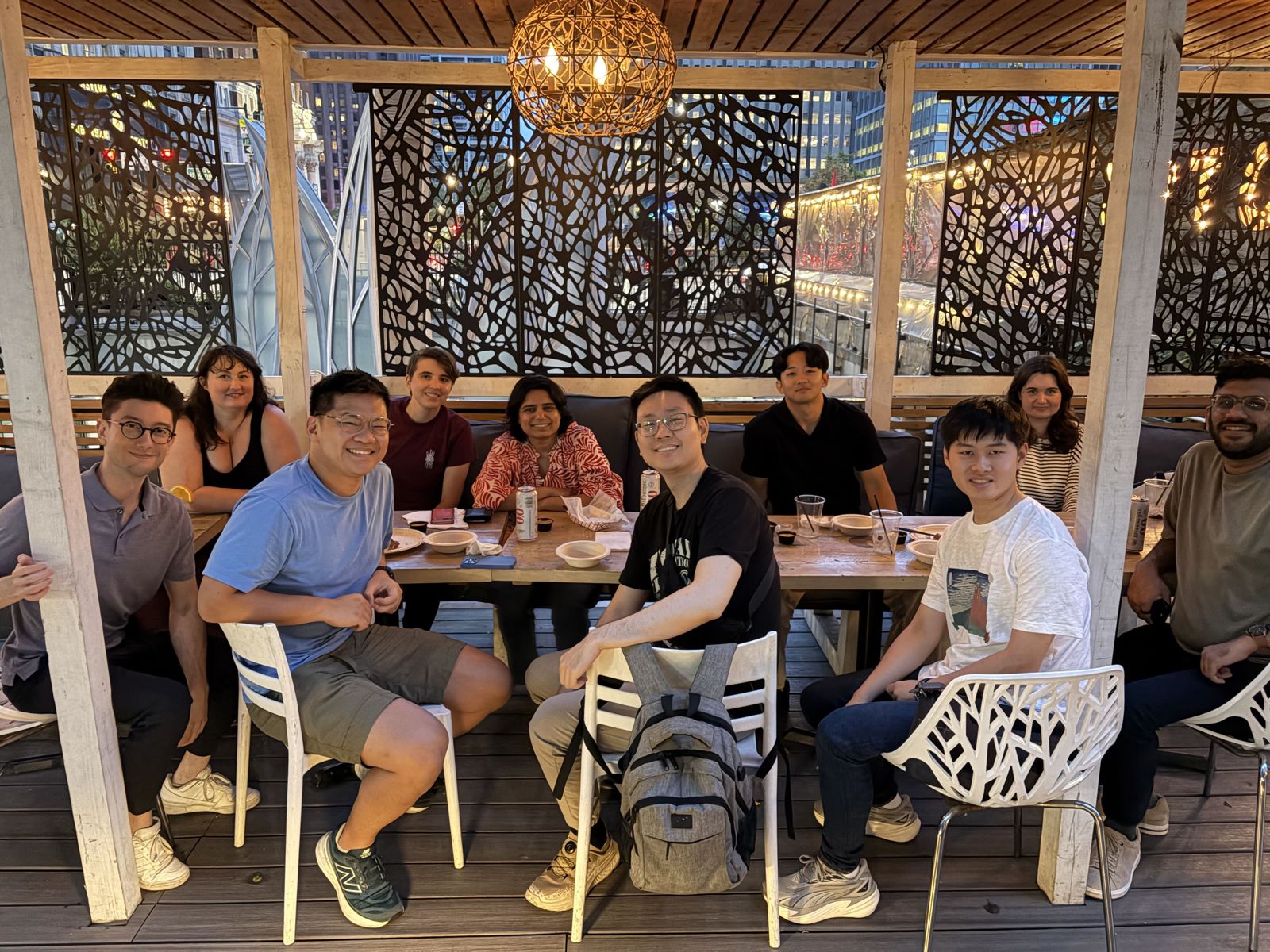
			Me with others from the UPenn MSE-AI Program
  </p>
  </small>
</center>

<p>It definitely wasn’t as booming as it was prior to 2020: there was less recruiter traffic through my inbox when I started looking, but I was still able to get the attention of a few. And while I don’t think I’m at a place in my career where I can easily pass an interview with a frontier lab, I’ve found that if you are more relaxed about where you work, there are still a good number of great opportunities available for senior+ engineers, especially at start-ups and scale-ups.</p>

<p>Part of that required me to be more comfortable using every available avenue. Aside from reaching out to friends for referrals (of which I am thankful I spent all of those in-person years at Gusto and Cocoon), I found that using agency recruiters was extraordinarily helpful (imagine scoring 4 interviews at once!) and that replying to every email or LinkedIn post is a good strategy. There’s no need to be picky before you get to the offer stage.</p>

<p>The bar for interviews now is much higher and more random as well. Honestly, I did not get a chance to do an AI interview (I was very eager to try one out!), but I felt like the focus of interviewing has shifted away from LeetCode and more towards system design, leadership, and behavioral questions. HelloInterview (not sponsored) was probably the best resource for me on all of these fronts.</p>

<h2 id="on-whether-its-good-to-take-a-break-from-work">On whether it’s good to take a break from work</h2>

<p>I think so. By the time I landed my job with <a href="https://ashbyhq.com/">Ashby</a>, I was very much excited and refreshed to go back to work, mostly because I felt like I had spent some time sharpening my principles on why I liked the work I did in the first place.</p>

<p><img src="/images/2026-09-27-My-time-away-from-tech/IMG_8658.JPG" alt="IMG_8658" /></p>

<center>
  <small>
    <p>
			My wife and I in Miami, the last place we visited during our break. I'm lucky to have her!
  </p>
  </small>
</center>

<p>It was easy to forget why when you’re constantly working. I easily get overwhelmed by my network’s achievements on social media, and it can feel like there’s a never-ending stream of work once you really get going in any role.  Sometimes, it was easier to just give up on myself than to really keep pushing myself forward.</p>

<p>Realizing that constantly pushing yourself to move forward, to be greater and better, to burn a candle at both ends, means you eventually run out of candle. And that humans need quality rest to prepare for the next big push. I’m so lucky and privileged to have been able to afford this quality time to rest for myself, and if you have the budget and the timing is right for you, you should take the leap. Your career and mental health will thank you for it.</p>]]></content><author><name>Jesse Zhou</name></author><category term="life" /><category term="career" /><category term="ai" /><summary type="html"><![CDATA[In December 2025, my wife and I decided it would be good for me to take a career break and focus a little more on myself. The stress of working at an early-stage startup since 2021 really took a toll on me, and I felt super burned out in the months leading up to my decision. We did some financial number-crunching and found that we could both afford not to work for up to a year. We decided to bite the bullet and commit.]]></summary></entry><entry><title type="html">The Veterans Still Matter</title><link href="dev.jezhou.com/2026/08/23/the-veterans-still-matter.html" rel="alternate" type="text/html" title="The Veterans Still Matter" /><published>2026-08-23T00:00:00+00:00</published><updated>2026-08-23T00:00:00+00:00</updated><id>dev.jezhou.com/2026/08/23/the-veterans-still-matter</id><content type="html" xml:base="dev.jezhou.com/2026/08/23/the-veterans-still-matter.html"><![CDATA[<p>I’m about to begin my part-time Master’s program at UPenn. Doing a program like this is a bucket list item for me, and I’m excited and nervous to be learning again.</p>

<p>I got to meet some of the others in the program last night for an unofficial happy hour. The range of people there was quite interesting - from Engineering Managers to full-time students, to those who have never had a software job. I felt like I was coming in with a unique perspective after having worked and lived in the Bay Area for 8 years.</p>

<p>One of the questions I found interesting was if I felt, in my time in industry so far, if the number of senior software engineering roles was capped. The thinking was that because it feels very difficult to find a job, there’s inevitably going to be people who can’t find opportunities to enter, and even those that stay in industry would eventually be laid off because of AI productivity gains.</p>

<p>My response was that I thought this was adopting a scarcity mindset on the industry in general. I think the right companies will continue growing their slice of the pie, in a way that contributes to more headcount overall, even with AI productivity gains. If you’re truly at a technology company, SWEs are the primary bottleneck to business impact, not just “more AI”. So it’s in the best interest of the company to continue hiring the right engineers, which should create a flywheel of new roles as the economic pie continues to grow.</p>

<p>I do think AI tools have made more companies treat software engineering as cost centers [1], but I also think many of these companies are finding out in a very hard way that they still need their veterans. There seems to be a level of intelligence seniors and staff+ have that LLMs cannot consistently replicate. And so, the shape of the world I’m betting on is that there’s going to be either the same number or more of senior SWEs + AI tooling, driving impact unless there’s another paradigm shift in AI that causes everyone to freak out again.</p>

<p>Maybe it’s not the level of intelligence that helps give seniors their job safety, but the ability to have one foot in the digital world, and the other in the real world. As a person, I don’t need to have the vast knowledge and know-how to quickly do everything the way a LLM does it, but I need to have the systems intuition to know when I see something that could catastrophically break many things, and also prioritize what would have the most impact from a product point-of-view.</p>

<p>Also, as a person, scoping and planning is deeper and richer because it requires <em>talking and building relationships with real people</em>, something that is always for some reason consistently undervalued, and is needed for any sufficiently meaningful project that is not just a vibecoded slop project.</p>

<p>My views on this have evolved a lot over the last year. Generally speaking, I was more of a doomer while I had a job and was grinding out Claude Code every day (maybe it’s my own version of AI psychosis). I partly attribute that to agentic coding being quite new (barely over a year old!).</p>

<p>But having spent some quality time away from the day-to-day SWE stuff over the last nine months and having seen AI intelligence plateau, I’m doubling down on my perspective that AI tooling is just that: a tool. And that any FUD or anxiety over how the current toolset will affect the senior engineering pool will stabilize in the long term, as organizations realize that human intelligence still cannot be beat for the product work that matters.</p>

<hr />

<ol>
  <li>Thinking back to just a few months ago when everyone (cough cough Dario) was saying SWEs and white collar were getting automated out very soon. I think anyone that has this perspective is vastly underestimating how much work the average white collar job has, and how slow it is to roll out innovative technology in older organizations. There’s a ton of complexity in reality that you cannot effectively feed into a LLM.</li>
</ol>]]></content><author><name>Jesse Zhou</name></author><category term="tech" /><category term="ai" /><summary type="html"><![CDATA[I’m about to begin my part-time Master’s program at UPenn. Doing a program like this is a bucket list item for me, and I’m excited and nervous to be learning again.]]></summary></entry><entry><title type="html">Building an iPhone app 95% from my phone</title><link href="dev.jezhou.com/2026/04/20/building-an-iphone-app-95-percent-from-my-phone.html" rel="alternate" type="text/html" title="Building an iPhone app 95% from my phone" /><published>2026-04-20T00:00:00+00:00</published><updated>2026-04-20T00:00:00+00:00</updated><id>dev.jezhou.com/2026/04/20/building-an-iphone-app-95-percent-from-my-phone</id><content type="html" xml:base="dev.jezhou.com/2026/04/20/building-an-iphone-app-95-percent-from-my-phone.html"><![CDATA[<p>I recently launched <a href="https://lingodex.app">Lingodex</a>, my first ever iPhone app on the app store! It’s a language flashcard app that uses LLMs to quickly create reference flashcards for you in a target language you want to learn.</p>

<p>I’ve been dogfooding it a bunch in China the last month, and have found it pretty useful for myself. Google Translate and Pleco are very useful, don’t get me wrong, but I sometimes I just needed to remember very specific slang or things that I just couldn’t find on Pleco (or were translated entirely wrong by Google Translate).</p>

<p>I wanted to write a little about my experience creating it. What made this particular side project different was that I couldn’t be in front of a computer most of the time to work on it: I’ve been jumping around China the last month, nomad style, visting family. So I had to figure out the best way to get most of the development done while on the subway, or before family dinners, or while on the train.</p>

<p>I maybe had an hour or two at our hotel / accommodation per day to be in front of the computer, so I had to reserve that computer time for the most essential tasks that required it (more about that in a bit).</p>

<p>Some principles I had to accept in order to code this flexibly are:</p>

<ol>
  <li><strong>Fully lean into mobile vibe-coding for all meaningful development.</strong> For me, this was the Claude Code Max 5x plan, using the Claude Code mobile app with their built-in remote environments. This allowed me to have a meaningful amount of compute per day for the ideas / iterations I wanted to make. Using Anthropic’s remote environments allowed me to avoid most <code class="language-plaintext highlighter-rouge">/remote-control</code> issues that stemmed from trying to get around the Great Firewall.</li>
  <li><strong>Taking out the laptop to work on this project is extremely high cost.</strong> While traveling in China, there was very little time to take out my laptop for some deep focus. Practically, this meant that Testflight was the only environment I tested changes in. I’m sure I could have spent more time figuring out how to have multiple environments for this app, but the experience I wanted was to sling an idea to Claude, have Claude do the work, and then have it show up somehow on my phone later without too much hassle. The less time I had to actually take out my laptop to submit or upload a build, the faster it would be for me to iterate.</li>
</ol>

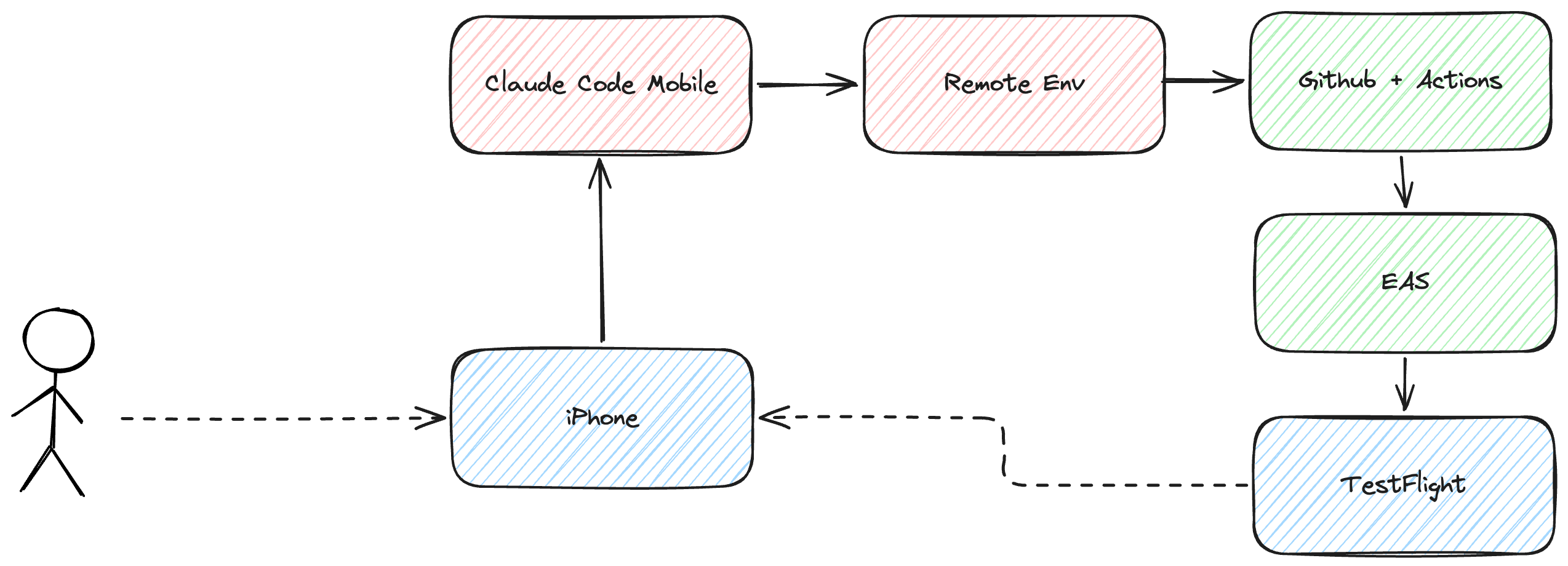
<p>In practice, applying the principles was easier said than done. But I found some success in following these principles by implementing the following development pipeline below.</p>

<p><img src="/images/2026-04-5-Nomadic-coding-with-agents/image-20260419074451321.png" alt="image-20260419074451321" /></p>

<p>In a nutshell, it order to be able to “sling ideas and have it show up on my phone”, I set up an EAS pipeline on Github actions to automatically take in any of my changes and build/submit to Testflight. I also had similar hooks for Supabase set up for things like database migrations and edge function deploys.</p>

<p>Overall, the “development loop” would look something like:</p>

<ul>
  <li>Test / dogfood the current version of the app</li>
  <li>Notice feedback</li>
  <li>Submit feedback to Claude Code via mobile</li>
  <li>Merge pull request via mobile</li>
  <li>Wait for EAS to build/submit</li>
  <li>Download the new version from Testflight</li>
  <li>Repeat</li>
</ul>

<p>And this was a GREAT loop to be in when a lot of my time was moving, exploring, and reconnecting with family. I would take 5 minute “Claude breaks” if I needed a breather from the other life things I needed doing. I’m surprised at how many ideas I had while on-the-go!</p>

<p>Some tradeoffs that came with these principles:</p>

<ol>
  <li>I basically didn’t even look at any of the code for this project, and I had to be ok with that. I did step in a few times to fix extremely minor issues, but otherwise this was a full “trust Claude to code, and trust my product sense” exercise.</li>
  <li>Mistakes would be shipped to Testflight often, especially when Claude misinterpreted what I had in my head. A lot of this could be fixed with clearer communication on my end, but some bugs were unavoidable.</li>
</ol>

<p>At the end of the day, the things that still took time on my laptop were:</p>

<ol>
  <li><strong>Debugging build failures.</strong> Every now and then, EAS would fail, or Supabase would fail, and I would need to step in and troubleshoot.</li>
  <li><strong>Debugging bigger bugs.</strong> Most bugs I noticed Claude could handle, but there were some that just required me to be locked-in in order to fix. In particular, integrating RevenueCat was a PITA since it was my first time doing so, and I for some reason could not get the annual plan to show up. I just ended up nuking the offerings I had and started over.</li>
  <li><strong>Integrating new APIs.</strong> Every time I needed to add a secret key for some third-party provider, I needed to do that on the command line. So this was unavoidable.</li>
  <li><strong>App Review materials.</strong> I underestimated how long it would take to do all of this. Apple asks for a lot and it required me to collect a lot of material in order to even submit something to the App Store. I’m sure there’s more to automate here too, with the App Store Connect API, but that’s a battle for another day.</li>
</ol>

<p>Overall, I’m proud of myself for getting all the way through for this app release. Who knew my first iPhone app would be made in such a weird, nomadic way?</p>]]></content><author><name>Jesse Zhou</name></author><category term="tech" /><category term="ai" /><category term="software-engineering" /><summary type="html"><![CDATA[I recently launched Lingodex, my first ever iPhone app on the app store! It’s a language flashcard app that uses LLMs to quickly create reference flashcards for you in a target language you want to learn.]]></summary></entry><entry><title type="html">Spec-Driven YOLO Development</title><link href="dev.jezhou.com/2026/03/06/Spec-Driven-YOLO-Development.html" rel="alternate" type="text/html" title="Spec-Driven YOLO Development" /><published>2026-03-06T00:00:00+00:00</published><updated>2026-03-06T00:00:00+00:00</updated><id>dev.jezhou.com/2026/03/06/Spec-Driven-YOLO-Development</id><content type="html" xml:base="dev.jezhou.com/2026/03/06/Spec-Driven-YOLO-Development.html"><![CDATA[<p>I’ve been having a ton of fun the last two weeks getting back into coding. I took a deliberate break the last 2 months to R&amp;R after quitting Cocoon.</p>

<p>While I was gone, I was surprised to learn how many things changed in the AI coding tools world. When I left Cocoon, it was the dawn of Opus 4.5 and skills. After coming back, there are now new paradigms and tools like OpenClaw and Gas Town. Models are now bumped - Opus 4.6 and Codex 5.3 are the SOTA. I’m glad I’m not working right now so I can easily catch up with all of the wild changes going on!</p>

<p>One workflow I’ve been appreciating lately is using an AI agent + some kind of spec-driven development tool to help guide and flesh out the thing I actually want to build. After experimenting a little with a few tools, my favorite one right now happens to be Github’s spec kit. Combined with a container that can help me safely bypass permissions, I find I can “one shot” many prototypes with barely any guidance.</p>

<p>The workflow works something like this:</p>

<ol>
  <li>Initialize spec kit, and chat with the workflow to define the kind of app or feature I want to build. Continuously refine the plan until it’s ready to implement. Use spec kit to break down the project into tasks.
    <ol>
      <li>Tip: You can let CC come up with the technical stack but I think after letting CC choose it for me once, I realize it’s always going to be better dictating the tech you already know so you can fix things manually if need be. CC chose Rust + Tauri for a desktop application I’m trying to make, and I unfortunately don’t have any Rust experience right now.</li>
    </ol>
  </li>
  <li>Spin up a container using <code class="language-plaintext highlighter-rouge">devc</code>, which I’ve found the most braindead way to set up a containerized environment for Claude Code.</li>
  <li>Set-up a multi-agent team that mirrors real-world development roles (back-end + front-end + QA + PM orchestrator + architect). Instruct the agent to spawn different agents with these roles and implement the feature.
    <ol>
      <li>I use the multi-agent teams feature Anthropic recently shipped to help make this more natural (docs here).</li>
    </ol>
  </li>
  <li>Let it rip! In ~30 minutes you get a prototype that’s maybe 70-80% there.</li>
</ol>

<p>I’m sure it would be easier getting to 100% in fewer shots, due to possible skill issues on my part. But it’s been an absolute <em>jam</em> getting ideas for projects out of my head, and into a working E2E prototype somewhere.</p>]]></content><author><name>Jesse Zhou</name></author><category term="tech" /><category term="ai" /><category term="software-engineering" /><summary type="html"><![CDATA[I’ve been having a ton of fun the last two weeks getting back into coding. I took a deliberate break the last 2 months to R&amp;R after quitting Cocoon.]]></summary></entry><entry><title type="html">2025 Year In Review</title><link href="dev.jezhou.com/2025/12/28/2025-year-in-review.html" rel="alternate" type="text/html" title="2025 Year In Review" /><published>2025-12-28T00:00:00+00:00</published><updated>2025-12-28T00:00:00+00:00</updated><id>dev.jezhou.com/2025/12/28/2025-year-in-review</id><content type="html" xml:base="dev.jezhou.com/2025/12/28/2025-year-in-review.html"><![CDATA[<p>As the Rolling Stones say, you sometimes don’t get what you want, but you get what you need.</p>

<p>2025 happened to be there year for me: a lot of accomplishments that were very different from the ones I wanted. But I did learn a lot!</p>

<p><img src="/images/2025-12-28-2025-year-in-review/72F3D609-E8CA-4317-BBB2-E3B2331CD711.jpeg" alt="72F3D609-E8CA-4317-BBB2-E3B2331CD711" /></p>

<h2 id="the-sub-4-marathon-journey-continues">The sub-4 marathon journey continues</h2>

<p>I’ve been hard-pressed this year to try and break the four hour marathon. I did two marathons this year: the Jersey City Marathon and the Philadelphia Marathon. Both times, I got shy of breaking 4 hours.</p>

<p>I was pretty disappointed after the Jersey City Marathon, because I did try very hard for that one and was probably in the best running shape in my life at that point, and crashed out due to poor strategy (aka running way too fast in the beginning).</p>

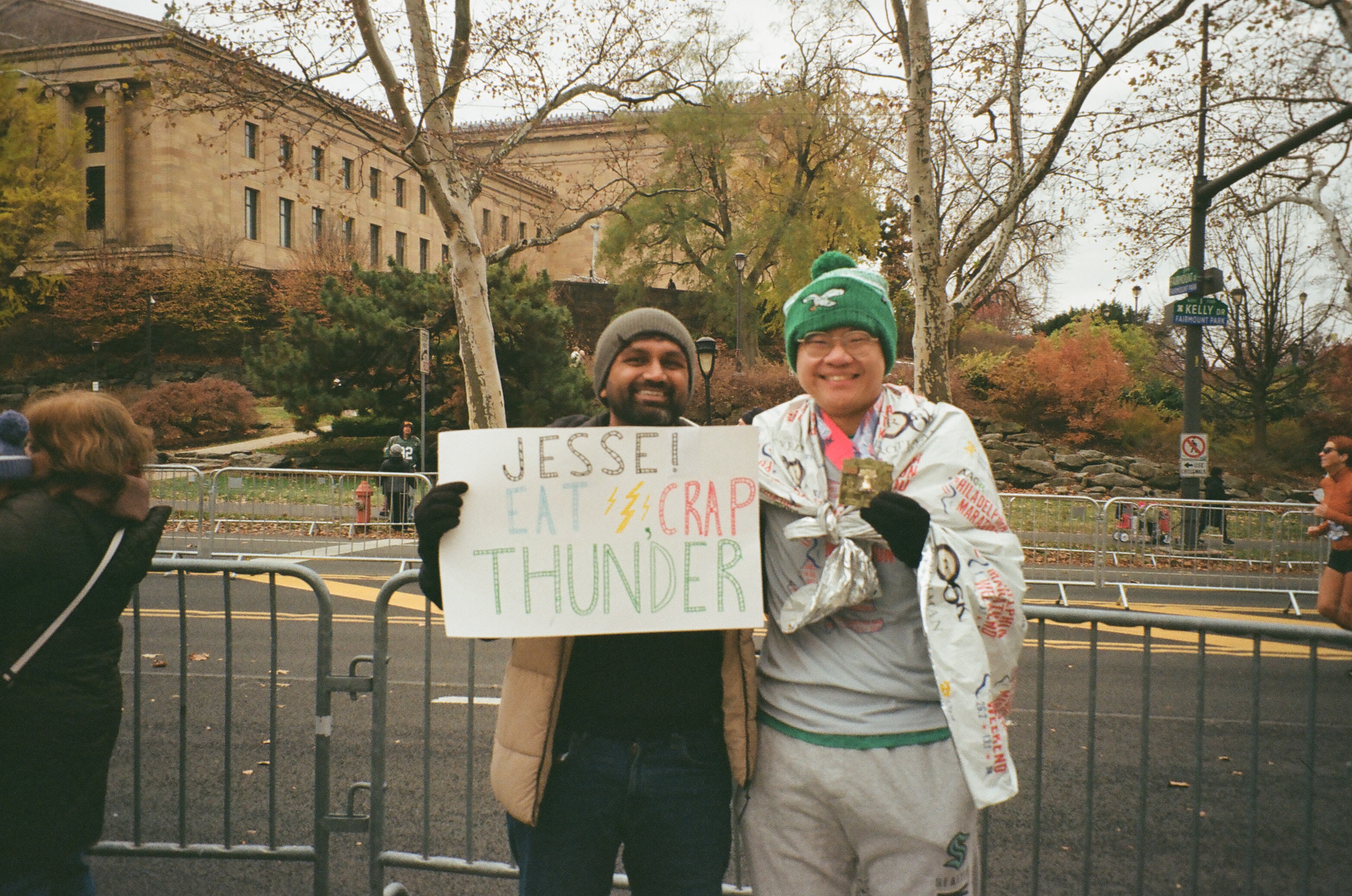
<p>The Philadelphia Marathon, I was less trained for unfortunately, but had a better strategy and ultimately a better time because of it. There was a point during the Philadelphia Marathon where I started laughing in a good way, around the 21-22 mile mark, because I realized that I wasn’t going to break four hours, but that I tried my absolute best and I shouldn’t ever feel bad about that.</p>

<p>Anyway, the journey continues next year. I am not lucky enough to do another two marathons due to my sabbatical plans, but will try to come back swinging for the Philly Marathon 2026.</p>

<h2 id="my-first-stint-at-management">My first stint at management</h2>

<p>Cocoon gave me the opportunity to try out engineering management for the first time. I definitely learned a lot through this experience - I personally didn’t really get as much satisfaction as I did from coding, but I did feel more accomplished seeing my direct reports accomplish and develop in the way they did. It was definitely a different kind of high, seeing someone develop a skillset with your intentional support over time.</p>

<p>I would say the pressure here is different from just being a mentor, or influencing from the side. I feel like in that kind of role, you can offer advice and nudges (which can still change the trajectory of how things are going), but you are not ultimately the arbiter of a person’s career. I’ve learned that being an EM very much means you are the arbiter in that regard, especially since you have access to more of the truth and chaos of the business.</p>

<p>This round of managing was hard since I was asked to balance it with my IC duties. The infamous TLM role! It was really hard being a TLM because as an IC, I get very emotionally invested in my projects, and sometimes that emotion can cloud judgement as a manager. Also, it was an extreme sap on my time - being an EM is a full-time job, and my opinion after doing it once is that anyone that is trying to be an IC or EM is probably overstretched in one area or both.</p>

<p>Overall, I decided after 9 months that while it was fun, being a TLM was a little hectic, and I wanted to spend more time advocating for the technology and being a full-time Staff Engineer again. I switched back to being IC for the remainder of my time at Cocoon.</p>

<h2 id="ai-programming-tools-come-back-swinging">AI Programming Tools come back swinging</h2>

<p>I took a short staycation in June this year, and at that time I really tried out Claude Code for the first time, and was utterly amazed at how good it was. I didn’t really understand agentic coding before trying out Claude Code, but I’m glad I did because it really opened my eyes on what the future of programming and AI can really be.</p>

<p>I had some exposure to Cursor before trying out Claude Code, and while that experience was magical as well at first, it feels too much like a walled garden, and I think no matter how much the Cursor team tries to make the IDE shinier, it’s hard to escape the gravitational pull of being an IDE. (I do realize that there is a cursor-cli, but I haven’t tried that yet since it didn’t feel like Cursor’s main product.)</p>

<p>Versus while using Claude Code, I’ve found my imagination is almost the limit for what I can do with it as a general agentic framework. I’ve found that you can use it for more than just writing code, which is very exciting to me. I’ve used it to help keep my notes organized, with some translation tasks I’m doing for a side project I’m working on, and much more [1].</p>

<p>That, and Anthropic continues to be on the forefront for creating new standards for agentic coding (like with Skills). Opus 4.5 was a marvel in the last 3 weeks I got to use it for professional work at Cocoon. I’m excited to see how companies like Anthropic continue to push the boundaries of coding.</p>

<p>Ultimately, I know I am looking at just the tide pool of an ocean of AI programming tools that exist right now. But I’m just marveling at how in 2024, my ceiling on what AI programming was was copy/pasting from ChatGPT, versus now it’s having a full-blown mini-army of agentic interns that can run in parallel to each other.</p>

<p>I was middle-of-the-ground unsure about programming with AI coming into 2025, but now at the end of the year, I can firmly say that I’m in the “this is the future” camp now [2]. I can’t wait to see and experiment on any new paradigms in tools that come in 2026.</p>

<h2 id="taking-the-next-step">Taking the next step</h2>

<p>Now that I’ve had more time to process my transition out of Cocoon, I’m happy to share a little more about how that decision was made. I decided after doing a backwards calculation that for what my wife and I want to do in the future, it makes sense for both of us to take an intentional sabbatical from work and spend time together, before our next phase of life. This gives us time to travel, for me to explore some of my own projects, and for me to really think about what I want to do as a next step without rushing [3].</p>

<p>It was a tough decision, a few months in the making, but once it was made it felt right in my gut. To me, a true gut feeling means a calm knowingness that it’s right, despite it being scary [4].</p>

<p>Telling my manager and skip manager wasn’t easy, but they were supportive of my decision and were excited for the next part of my journey. I’m lucky enough to have had very understanding managers at Cocoon, and I’m thankful that my exit was handled with a lot of grace.</p>

<p>If there’s one piece of advice here that I’ve learned, is that the goldilocks amount of time for a proper transition out is one month. Any more than that and you are just wasting people’s time and your own opportunities, any less than that could be rushed especially if you have some kind of leadership role. So if you can afford to do so and are lucky enough to have a graceful exit, shoot for letting your bosses know one month in advance.</p>

<p>Ultimately, I can already feel myself itching to go back, but I’m trying to not rush the next move. I’m taking time to really internalize what I need for my next role in a careful and delibrerate way. Of course, I am planning to write some extended thoughts on how I’m planning for and making this choice when it’s time.</p>

<hr />

<p>[1] I’m very much due to writing a bigger blog post about this, but in just a sentence, I think that if you have some baseline coding skills and you have access to Claude Code, you have pretty much all the AI functionality you will ever need, coding and beyond.</p>

<p>[2] I am very aware of the AI bubble talk and I think one can treat the financial side of AI and the utility side of AI with different mindsets. These tools are genuinely useful, and have helped me accomplish things much faster with less cognitive overhead! But it is genuinely crazy how much money is being poured into these tools, with the hope they will replace ALL valuable forms of white collar work.</p>

<p>[3] This is a <a href="https://mollyg.substack.com/p/time-off">great article</a> by Molly Graham that made me change my perspective on intentional breaks between jobs.</p>

<p>[4] Sometimes, it can be easy to confuse gut decisions with excited decisions, but excited decisions, IMO, can be more dangerous because you are not fully processing the information. You are making a decision on passion and “vibes”, and you can unfortunately reap what you sow if you’re not careful.</p>]]></content><author><name>Jesse Zhou</name></author><category term="life" /><summary type="html"><![CDATA[As the Rolling Stones say, you sometimes don’t get what you want, but you get what you need.]]></summary></entry><entry><title type="html">Farewell Cocoon!</title><link href="dev.jezhou.com/2025/12/15/farewell-cocoon.html" rel="alternate" type="text/html" title="Farewell Cocoon!" /><published>2025-12-15T00:00:00+00:00</published><updated>2025-12-15T00:00:00+00:00</updated><id>dev.jezhou.com/2025/12/15/farewell-cocoon</id><content type="html" xml:base="dev.jezhou.com/2025/12/15/farewell-cocoon.html"><![CDATA[<p>I have been deciding for a few months whether it was time for me to make the hop from Cocoon, and I decided recently that it was the right thing for me to do.</p>

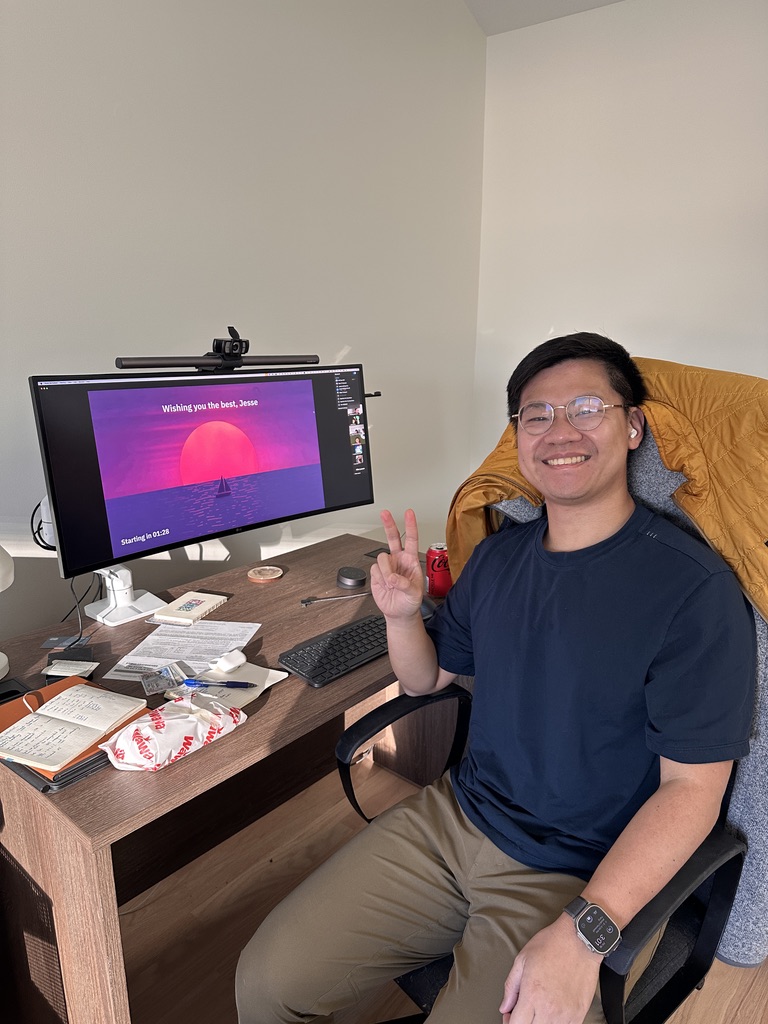
<p>My last day was on Friday, December 12th. Here’s me about to go into my farewell zoom:</p>

<p><img src="/images/2025-12-14-farewell-cocoon/2B747C77-0C0E-4877-8295-1A797A2A3AC9_1_105_c.jpeg" alt="my-last-day-at-cocoon" /></p>

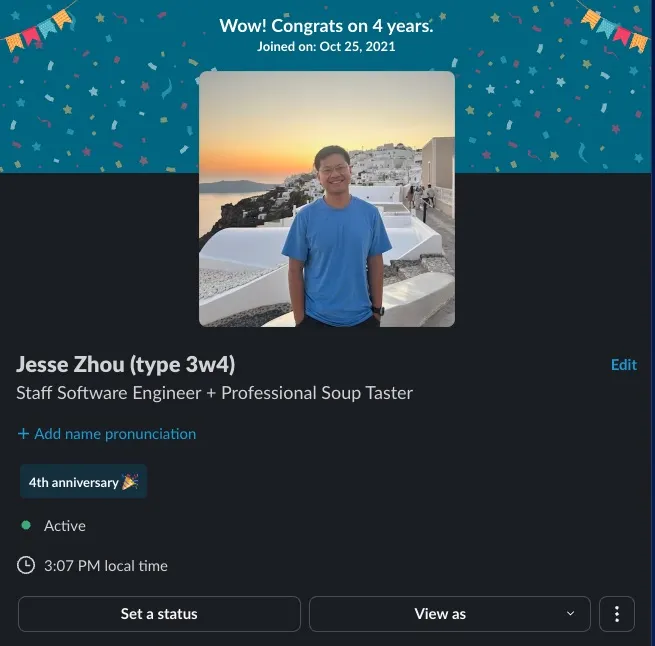
<p>I’ve spent a long time at Cocoon – I joined from the very early Series A days (basically, right when we raised) and have seen the company through a product pivot and awesome growth.</p>

<p>I built some really cool features, supported so many engineers in my role, and overall learned a ton about what makes a venture-backed startup a successful one.</p>

<p><img src="/images/2025-12-14-farewell-cocoon/A60EB745-8353-4C2D-8A0C-C069D7331648_1_102_o.jpeg.png" alt="proof-of-4-years-cocoon-slack" /></p>

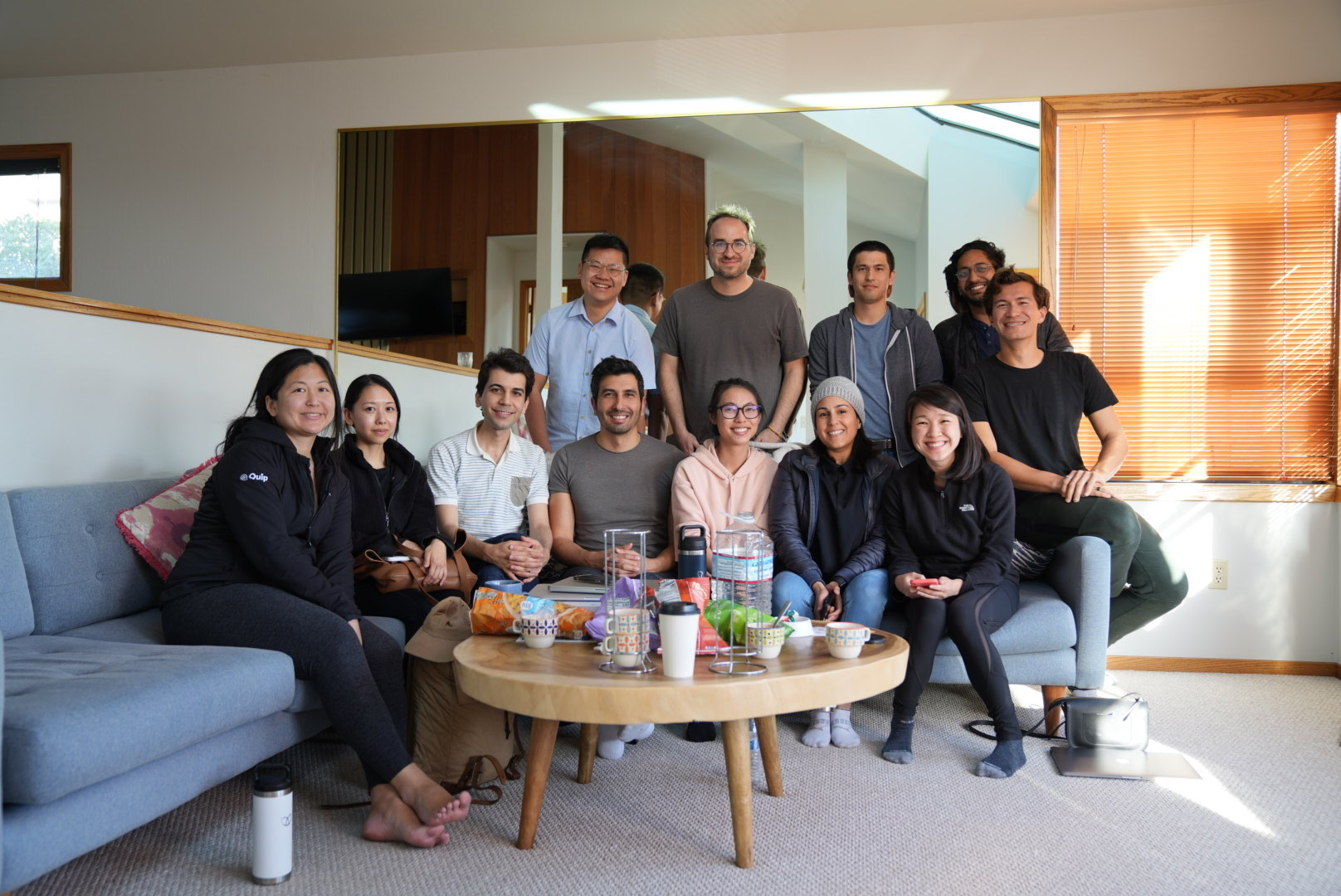
<p>The makeup of the team was very different when I first joined. Here’s a picture of the team at my first EPD offsite:</p>

<p><img src="/images/2025-12-14-farewell-cocoon/first-epd-cocoon-team.png" alt="first-epd-cocoon-team" /></p>

<p>Here’s a picture of the team at my last EPD offsite:</p>

<p><img src="/images/2025-12-14-farewell-cocoon/last-epd-cocoon-team.png" alt="last-epd-cocoon-team" /></p>

<p>I have so much to write about Cocoon, but there are too many lessons here to fit in a single post. So for now, I will say that I had the time of my life here, and that I followed Mahima and the team through the ups and downs all because the mission has always resonated with me.</p>

<p>Employee Leave is a hard problem. Ask any working parent, injured employee, or exhausted caregiver how hard it is. There are so many rules and regulations you have to follow, all while going through one of the most emotional parts of your life. Capturing those rules and regulations in meaningful and empathetic software is incredibly difficult.</p>

<p>It’s also a much larger problem than the layman thinks it is. There are so many kinds of leave you probably don’t think about but are there in case you need it: Parental Leave, Military Leave, Leave as an Accommodation, Personal Leave, Bereavement Leave, Miscarriage Leave. The list goes on and on and the set of rules gets more and more complex.</p>

<p>To be motivated to work on this problem day-in and day-out for four years required dedication and passion about how painful this problem is. I’m glad I was able to find that motivation in myself to do it for so long. 4 years at a startup is a long time!</p>

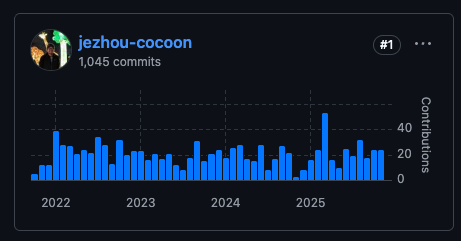
<p><img src="/images/2025-12-14-farewell-cocoon/cocoon-contributions.png" alt="cocoon-contributions" /></p>

<p>I will continue to root for this team every day from the sidelines: they’re an incredible engineering team (and <a href="https://www.cocoon.com/careers">they’re still hiring</a>). For now, it’s important for me to spend more time with my family and give myself a break from the hustle-and-bustle of startup life. I’m also excited to spend some time learning more intentionally about AI tooling and technologies, which I got to experience a lot of while at Cocoon but haven’t done a deep dive into yet from a first principles standpoint. Expect more from me on these topics soon!</p>

<p>And of course, one of my goals is that I will keep writing here on a regular cadence. This will be a busy sabbatical for myself, and I can’t wait to keep writing about my learnings and experiences throughout it all. 🎉</p>

<p>But until then: Cocoon, thanks for everything. Keep empowering people to take time when they need it most. 🙂</p>]]></content><author><name>Jesse Zhou</name></author><category term="life" /><category term="career" /><summary type="html"><![CDATA[I have been deciding for a few months whether it was time for me to make the hop from Cocoon, and I decided recently that it was the right thing for me to do.]]></summary></entry><entry><title type="html">Staff Archetypes - Jack of All Trades, or Master of One?</title><link href="dev.jezhou.com/2025/11/03/flounder-mode-3-staff-archetypes-jack-of-all-trades-or-master-of-one.html" rel="alternate" type="text/html" title="Staff Archetypes - Jack of All Trades, or Master of One?" /><published>2025-11-03T00:00:00+00:00</published><updated>2025-11-03T00:00:00+00:00</updated><id>dev.jezhou.com/2025/11/03/flounder-mode-3-staff-archetypes-jack-of-all-trades-or-master-of-one</id><content type="html" xml:base="dev.jezhou.com/2025/11/03/flounder-mode-3-staff-archetypes-jack-of-all-trades-or-master-of-one.html"><![CDATA[<p><img src="/images/2025-11-03-flounder-mode-3-staff-archetypes-jack-of-all-trades-or-master-of-one/Photo%20from%20Buttondown.jpeg" alt="Photo from Buttondown" /></p>

<center>
  <small>
    <p>
    Photo by <a href="https://unsplash.com/@halfcutpokemon?utm_source=Buttondown&amp;utm_medium=referral&amp;utm_campaign=flounder-mode-3-staff-archetypes-jack-of-all">Halfcut Pokemon</a>
  </p>
  </small>
</center>

<p>The first resource most managers send you once you flag your interest in being a Staff Engineer is <a href="https://staffeng.com/guides/staff-archetypes/?utm_source=flounder-mode&amp;utm_medium=email&amp;utm_campaign=flounder-mode-3-staff-archetypes-jack-of-all">the one that describes the four archetypes</a>.</p>

<p>A common question that comes up is trying to figure out which archetype suits you and your strengths as a person. For some folks, it can be very obvious which archetype one gravitates towards; for others, it’s not obvious which one you should choose, and you sort of just go off of “vibes”. Very much like choosing a starter Pokemon!</p>

<p>As I was trying to figure this out, I asked a ton of questions to my then skip-manager, who was the one that originally inspired me to even try and go for the promotion. I laser-focused on the archetype that I perceived to be closest to my strengths, which was The Tech Lead. I immediately discounted the one that I thought seemed boring and not aligned with my strengths, which was the Right Hand.</p>

<p>However, at some point, my skip-manager told me the following:</p>

<blockquote>
  <p>“You can’t just focus on one archetype. You have to be somewhat good at all four archetypes, eventually. So try not to index your whole career on just being good at the Tech Lead archetype.”</p>
</blockquote>

<h2 id="using-attitude-as-a-mechanism-for-shifting-archetypes">Using attitude as a mechanism for shifting archetypes</h2>

<p>Looking back, this advice aligns tightly with <a href="https://buttondown.com/flounder-mode/archive/flounder-mode-2-the-t-shaped-employee/">last week’s post on being a T-Shaped employee</a>: it’s fine to play your strengths and work consistently within a single archetype, but going out of your comfort zone to practice the other Staff Archetypes every now and then helps keep the doors of opportunity open.</p>

<p>I’ve found this to be especially true during the latter half of my tenure at Cocoon. I don’t know if it’s due to the necessity of wearing many hats at a startup, but even though I was most interested in being a Tech Lead, there were many instances where I’ve had to morph into the other archetypes, even if they aren’t naturally what I’m good at [1].</p>

<p>One technique that has helped me “morph archetypes when needed” is to just adopt an attitude of Getting Stuff Done As Soon As Possible (GSD-ASAP). If you have an attitude like that and you’re creative enough, you will find yourself naturally changing your personality and how you work to fit whatever situation is in front of you.</p>

<p>For example, you may not be the best negotiator in the world, but if the fastest way to finish a project is to find a vendor that does the exact thing you’re looking for and build an integration with them, suddenly you’re reading <a href="https://www.goodreads.com/book/show/123857637-never-split-the-difference?utm_source=flounder-mode&amp;utm_medium=email&amp;utm_campaign=flounder-mode-3-staff-archetypes-jack-of-all">Never Split The Difference</a> and getting on calls with their sales team, while reading their documentation on how to integrate their product quickly with what you’re building [2].</p>

<p>GSD-ASAP is a muscle that needs consistent flexing to strengthen over time, but it’s one of those things that click once you’ve done it enough.</p>

<h2 id="the-archetypes-are-lighthouses">The archetypes are lighthouses</h2>

<p>Just like how you shouldn’t overspecialize in one area of software engineering, don’t corner yourself into only being a single Staff Archetype.</p>

<p>While the archetypes are helpful as a reference, I prefer to use them as directional lighthouses of how I need to be acting within a certain context, to make whatever outcomes I’m focusing on successful.</p>

<p><strong>The best part about all of this is, you don’t need to be a Staff Engineer to have a GSD-ASAP attitude! It’s something you can adopt at any point in your engineering career.</strong></p>

<p>As long as you have that attitude and these directions, you’ll be able to navigate confidently through whatever chaos you find yourself in, and maybe have your roles and responsibilities evolve along the way.</p>

<hr />

<h3 id="footnotes">Footnotes</h3>

<p>[1] I’ve been in positions where I needed to influence our leadership to make certain decisions on our projects and the technology we’re using, which is very much a Right Hand thing. I’ve also been deployed to “urgent and important” situations, which is very much a Solver thing. And sometimes, I’ve had to zoom way-the-fuck out to think about a problem from first principles, which is very much an Architect thing.</p>

<p>[2] I had to do this when building out our historical leave import process at Cocoon. We partnered with a third-party to help us transform raw CSV data into domain objects that could be used by our product. Cocoon is not a CSV processing company, nor should we be, so this was one of those classic build-vs-buy moments where it was faster to buy a solution we could integrate in our processes.</p>]]></content><author><name>Jesse Zhou</name></author><category term="life" /><summary type="html"><![CDATA[]]></summary></entry><entry><title type="html">The T-Shaped Employee</title><link href="dev.jezhou.com/2025/10/20/flounder-mode-2-the-t-shaped-employee.html" rel="alternate" type="text/html" title="The T-Shaped Employee" /><published>2025-10-20T00:00:00+00:00</published><updated>2025-10-20T00:00:00+00:00</updated><id>dev.jezhou.com/2025/10/20/flounder-mode-2-the-t-shaped-employee</id><content type="html" xml:base="dev.jezhou.com/2025/10/20/flounder-mode-2-the-t-shaped-employee.html"><![CDATA[<p><img src="/images/2025-10-20-flounder-mode-2-the-t-shaped-employee/Photo%20from%20Buttondown%20(1).jpeg" alt="construction man" /></p>

<center>
  <small>
	<p>
    Photo by <a href="https://unsplash.com/@jeriden94?utm_source=Buttondown&amp;utm_medium=referral&amp;utm_campaign=flounder-mode-2-the-t-shaped-employee">Jeridan Veillegas</a>
  </p>  
    </small>
</center>

<p>In my first year at Gusto, I remember getting dinner and drinks with a senior engineer I was working on a project with. I asked him a question that was bothering me as a junior engineer.</p>

<p><strong>“How do I know when I should specialize in a certain area of engineering? How do I know if I’m a front-end engineer, back-end engineer, or something else?”</strong></p>

<p>He gave me a response that I’ll always remember:</p>

<blockquote>
  <p>“I just try and be a good <em>engineer</em>. I’m not a back-end engineer or a front-end engineer. Just a plain old engineer. I think specialization can corner you too early if you’re not careful.”</p>
</blockquote>

<p>I didn’t know it would stick with me so much until later on at Gusto. At around year two or three, I had a small six month stint as a Design Systems engineer, mainly because I thought I was interested in front-end, and that working with the Design Systems team would help grow and bolster my love for it.</p>

<p>While that experience did teach me a lot, I was firmly locked into the Design Systems space for a bit. The thing about Design Systems is that you are really a kind of infrastructure team, so domain-specific opportunities tend to not come your way.</p>

<p>What I considered juicier business and career opportunities at Gusto were nabbed by generalist peers that weren’t firmly in a specialization bucket yet.</p>

<p>Upon reflection, I believe I specialized a little too early for a little too long. After my stint, I was determined to boomerang back to the generalist track, and not just peg myself as a front-end focused engineer anymore.</p>

<p>I’m always glad I made that choice for myself. But a secondary, follow-up question itched at me for awhile after.</p>

<p><strong>“How do you reconcile a passion for a certain engineering skill tree, with the benefits of being a generalist?”</strong></p>

<p>Obviously, software engineering encompasses so many different skills. It’s impossible to be good at all of them. Because engineers themselves are so diverse, they naturally feel a pull to specialize on what they’re passionate about.</p>

<p>However, in a world that changes as fast as technology, there is a risk that specializing in a skill you’re passionate about will force you to re-skill when that speciality isn’t relevant anymore, or as new skill trees emerge. (This is especially relevant in the age of AI.)</p>

<p>I got a great answer to this second question from one of my managers at Gusto later on:</p>

<blockquote>
  <p>“Strive to be the T-Shaped employee. You need to have a broad range of skills you can always rely on, but a specialization you can go deep in to stay motivated.”</p>
</blockquote>

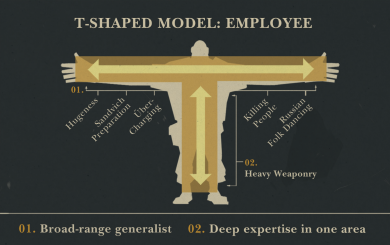
<p><img src="/images/2025-10-20-flounder-mode-2-the-t-shaped-employee/t-shaped-employee.png" alt="t-shaped-employee" /></p>

<center>
  <p>
    <small>
      From the <a href="https://www.valvesoftware.com/en/publications?utm_source=flounder-mode&amp;utm_medium=email&amp;utm_campaign=flounder-mode-2-the-t-shaped-employee">Valve Employee Handbook</a>. Worth a read!
      </small>
  </p>
</center>

<p>T-Shaped employees provide incredible value because they are theoretically adaptable to any project, yet have one area of deep specialization they are passionate about and can be multipliers in if needed. They are not asked to be good at <em>everything</em> but <em>just good enough</em> to get urgent and important jobs done.</p>

<p>This is especially important at startups where the ratio of engineers to jobs-to-be-done is far too small. Being a T-Shape at a smaller startup is a necessity, not a nicety!</p>

<p>However, it is hard to be a T-Shape, at least in some respects.</p>

<p>It’s not hard to stay motivated about the “deep” part of the T: that part comes naturally as a part of passion and interest.</p>

<p>It’s the horizontal part of the T that is difficult to maintain. It requires going out of your way to do projects that might not be in your natural skillset, which you might be only willing to do so often. But my recommendation is that even tiny opportunities can help maintain the T-Shape.</p>

<p>Most companies these days, for example, still do the internal quarterly hackathon, and that is a great opportunity to grind your gears on something new. If your company has a good PTO policy, taking a day off to just explore new trends or start a side project is another great way to keep your T-Shape in form. Picking up a ticket or two that’s out of your wheelhouse per development cycle can also get you out of your comfort zone.</p>

<p>I’ve found sticking to this as a career principle has opened up a lot of doors at the companies I’ve worked at. Funnily enough, I had the opportunity to do highly visible Design Systems related projects at Cocoon because of the time I spent doing it at Gusto. It turns out, that six-month stint had a payoff that was so far in the future, I couldn’t even see it coming!</p>

<p>You never want to say “no” to a huge opportunity because you don’t have the minimum skillset required to be effective. Spend time growing your T-Shape, and you’ll always be ready when the opportunity comes knocking at your door.</p>]]></content><author><name>Jesse Zhou</name></author><category term="life" /><summary type="html"><![CDATA[]]></summary></entry><entry><title type="html">System Shock</title><link href="dev.jezhou.com/2025/03/20/system-shock.html" rel="alternate" type="text/html" title="System Shock" /><published>2025-03-20T00:00:00+00:00</published><updated>2025-03-20T00:00:00+00:00</updated><id>dev.jezhou.com/2025/03/20/system-shock</id><content type="html" xml:base="dev.jezhou.com/2025/03/20/system-shock.html"><![CDATA[<p>I recently took a course in Systems Thinking through the MIT xPRO online learning program, and I found it very useful. The class gave me a good foundation on how various systems work, as well as a language I can use to broadly describe technical and non-technical systems.</p>

<p>I was actually able to apply some of this knowledge at work through a workshop I made up called a “System Shock”. The context of the workshop was that Q125 at Cocoon was one of the most hectic / busiest quarters in the company’s history, and as a result our EPD team was shipping a ton of projects at the same time.</p>

<p>With Systems Thinking, it’s always about controlling desirable emergent behaviors from the system. This means that each project, scoped and spec’d on its own, needs to ultimately work as expected with other projects, even if no one thought about how the two projects should really fit together.</p>

<p>The funny thing about having ~8 concurrent projects, all of which have tight deadlines, is that you tend not to think about this since you’re so locked in on completing your own project.</p>

<h2 id="the-workshop">The workshop</h2>

<p>So using the stuff I learned from this class, I created System Shock, which is a workshop designed to find the gaps and cracks between projects.</p>

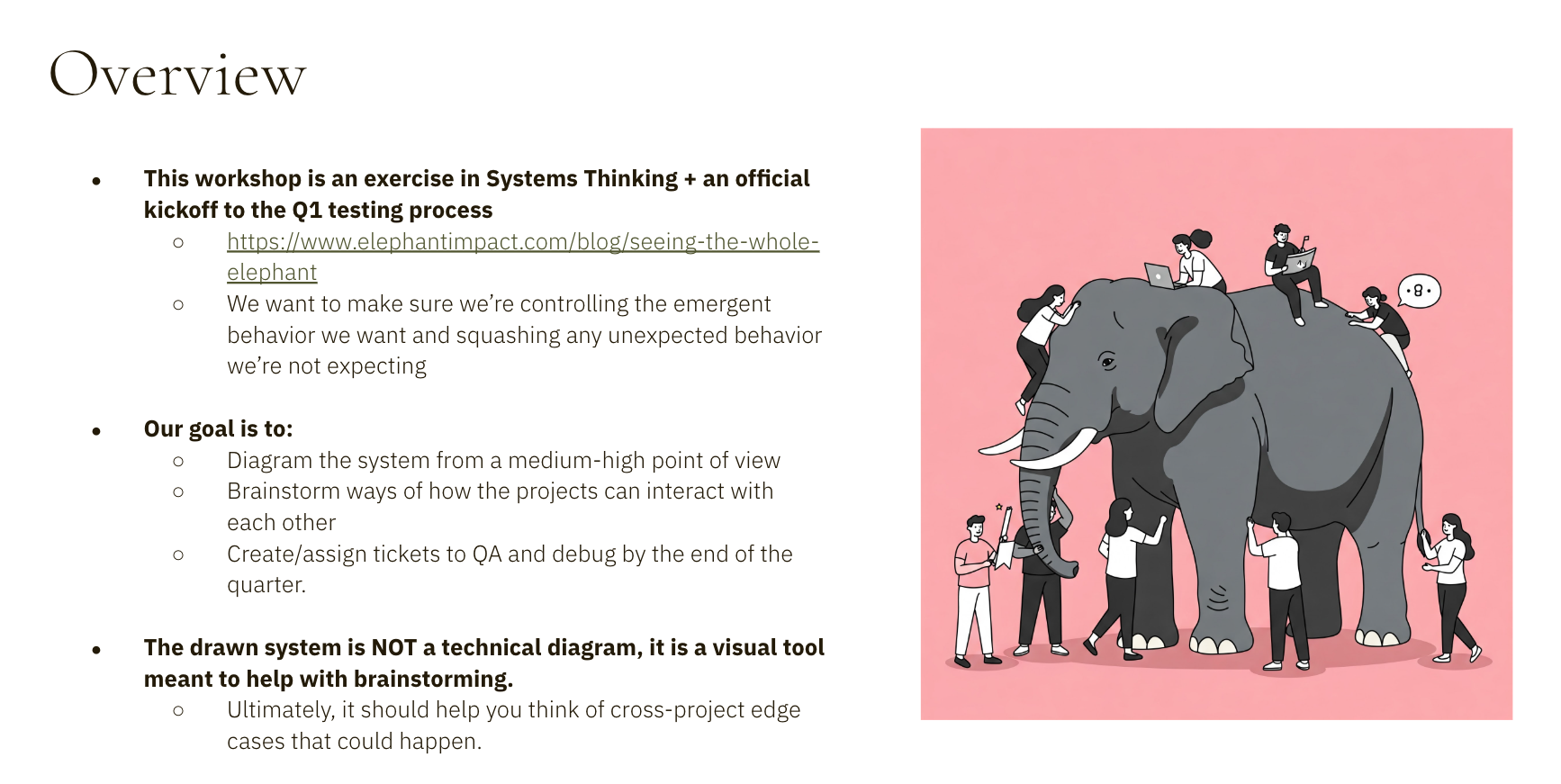
<p><img src="/images/2025-03-20-system-shock/slide-1.png" alt="img" /></p>

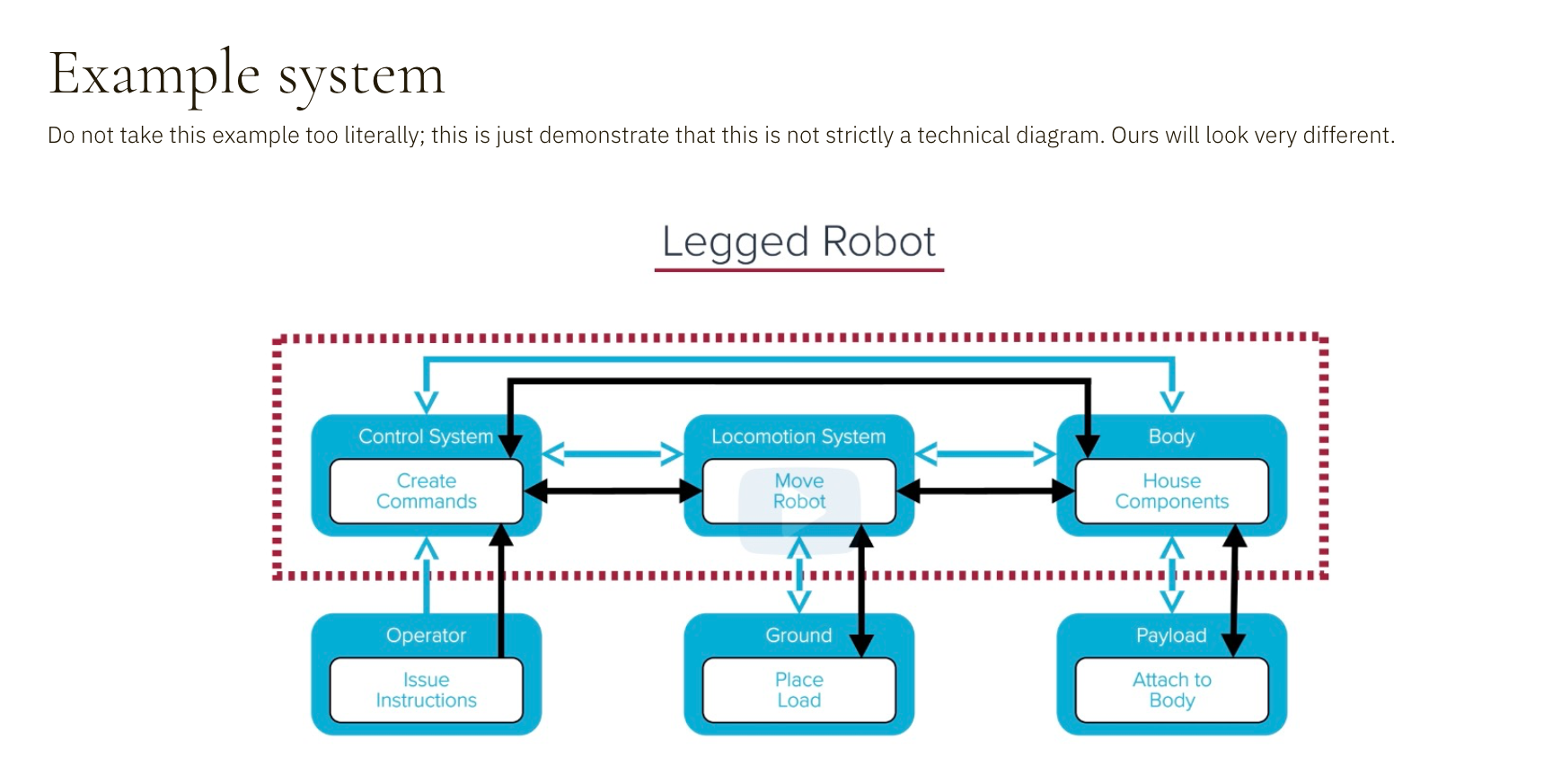
<p><img src="/images/2025-03-20-system-shock/slide-2.png" alt="img" /></p>

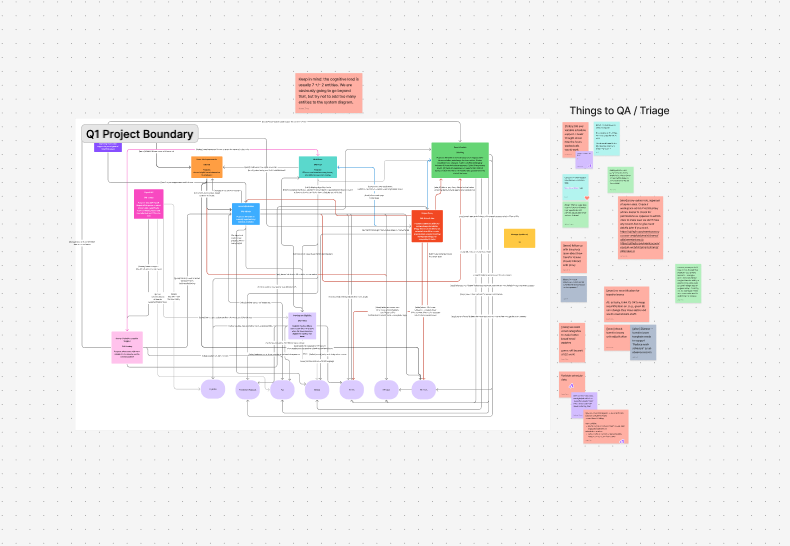
<p>I put a very heavy emphasis on not worrying about drawing a technical diagram, only focusing on abstract boxes and arrows to diagram out different behaviors between projects. Each box represented a project we worked on this quarter, each oval represented some foundational element of our system that could be affected (the “System Context”), and each arrow represented some way each project affected another entity in the system.</p>

<p>We started off with just an empty diagram of boxes, and gave a 1-min soapbox to every Project DRI to explain their project to the group. Then we spent 10-15 minutes drawing the arrows between projects.</p>

<p>We used Figjam to map out all of the interactions, and it was a beautiful, chaotic orchestration of thoughts. All of the text in this photo is redacted for obvious reasons, but you can see how complex the behavior of just our Q1 projects were just from a high-level point of view!</p>

<p><img src="/images/2025-03-20-system-shock/slide-final.png" alt="img" /></p>

<p>After we mapped out everything, we spent the remainder of the time (20-25 minutes) just quietly looking at the diagram of interactions, and writing down things to QA/test on the right. We were able to create a lot of tickets and assign them to the right owners.</p>

<p>The great thing about these tickets is that they were designed to involve two or more projects, which meant natural opportunities to learn about other projects / pair program on fixing issues together.</p>

<h2 id="was-it-worth-it">Was it worth it?</h2>

<p>In the end, we figured that this exercise was highly interactive and had high engagement when we explained it well, which is really great especially considering our company is mostly remote. However, it does require some degree of follow-through to make sure tickets are assigned and completed by the right people.</p>

<p>I think we did this exercise a little too late in the quarter, so ideally it’s something you do as more of a pre-mortem than a post-mortem after the quarter is over. Ideally most of these cases are captured before projects are completed and not retroactively patched afterwards.</p>

<p>Overall, the team really loved the exercise and I’m planning on doing it more frequently in the future. If there is a better name for this exercise (because I’m sure there’s a version of this that already exists, this hardly seems like a novel workshop to me), please feel free to email me and I can add an additional note to reference it!</p>]]></content><author><name>Jesse Zhou</name></author><category term="tech" /><summary type="html"><![CDATA[I recently took a course in Systems Thinking through the MIT xPRO online learning program, and I found it very useful. The class gave me a good foundation on how various systems work, as well as a language I can use to broadly describe technical and non-technical systems.]]></summary></entry><entry><title type="html">Have a Direction, Not a Plan</title><link href="dev.jezhou.com/2024/11/17/have-a-direction-not-a-plan.html" rel="alternate" type="text/html" title="Have a Direction, Not a Plan" /><published>2024-11-17T00:00:00+00:00</published><updated>2024-11-17T00:00:00+00:00</updated><id>dev.jezhou.com/2024/11/17/have-a-direction-not-a-plan</id><content type="html" xml:base="dev.jezhou.com/2024/11/17/have-a-direction-not-a-plan.html"><![CDATA[<p>When I was in school, I remember during my freshman orientation course for Computer Science, one of the professors said that if you want to do the 5-year Master’s degree track, you had to “plan ahead”. This mean having a strict plan of the courses you were going to take per quarter, and making sure they all added up accordingly so that you could graduate with a Master’s degree within those 5 years.</p>

<p>I didn’t take that track because I didn’t want to at that time, but even as college went on, I found the generic wisdom of that advice to be flawed:</p>

<ul>
  <li>There were so many people fighting for the classes they wanted to take, especially in an impacted CS program that seemed to have more students than it had classes. So there was no way that a highly rigid gameplan would have survived beyond maybe the 1st year of classes.</li>
  <li>Reflecting on everything that has happened in college, there was a lot of unpredictable life things that affected my motivation and schedule during those years. I think people who were extremely focused on getting that Master’s degree, and didn’t have anything super distressful happen to them, would have had their original plans intact.</li>
</ul>

<p>After 7 years in the work force, I’ve realized that it’s always better to have a direction of where you want to go versus having a strict plan. Plans are inherently inflexible and brittle; if one thing goes wrong and you can’t adapt the plan, then everything breaks for a bit. Directions are more fuzzy and anti-fragile; even if something goes wrong, you can adapt and adjust the direction, and still move forward.</p>

<h2 id="that-time-when-my-plan-went-wrong">That time when my plan went wrong</h2>

<p>I wrote about this very early on (🚸 On competitive Bay Area high schools and their rippling effects) but I distinctly remember in high school, I had a plan to go to a top tier university. It required years of focused concentration on AP classes, bringing my “A game” to every sport and club I joined, and generally just giving my heart and soul into becoming the best candidate for the college I wanted to go to.</p>

<p>This plan was like a house of cards. All it took was a “B” in a class for the balloon of pressure to pop for me, because getting a “B” was not part of the plan. And that’s basically what happened. I thought my plan, and my life was over at that point. Seems very, very, very silly now that I reflect on it as a 29 year old. But that is an example of how worshipping a plan can go way too far, and affect you mentally as a person if you try to stick too much with it.</p>

<p>I often say this to my friends in real life, but I wish I had more of a direction in high school, because it would’ve allowed me to zoom out and think of the bigger picture. In hindsight, my plan and goals at this point in life were very naive. I’ve learned that it really doesn’t matter which college you go to, so long as you learn and network with the right people accordingly. A better direction would have been to learn as much as I can, and to work more on self-discovery and what I enjoyed doing, not just what would’ve gotten me into a good school.</p>

<p>There were friends in high school that had that direction, and I can say that today they’re much better for it.</p>

<h2 id="what-is-a-direction">What is a direction?</h2>

<p>Overall, I would describe having a good direction as having a very loose plan instead of a strict one, where you fill in the minor details along the way, and are open to adjusting if things need to stall or something goes wrong for a bit.</p>

<p>One thing that has always helped me maintain direction is to build optionality at certain waypoints in life. Basically, a series of “if-this-then-that” forks. You never want to feel like you’re stuck because things aren’t going according to plan. In the college example, I always had a handful of 3 or 4 classes that I could sign up for, even if they weren’t exactly interesting to me. Mostly because I was able to determine that the direction I wanted was a technical degree and a SWE job, and whatever helped me get that was “good enough” for the plan (even though looking back, there were a few interesting classes I missed out on).</p>

<p>Another more recent example: I had no idea that this year I would move to Philadelphia, but it directionally made sense for myself and Jillene because she wanted to go into a great nursing school program, and I wanted a change of pace and escape the SF monoculture for a bit. I don’t think we knew until March that this was going to happen. But it was directionally aligned, and it ended up being a great decision for us and our current life stage.</p>

<p>Another thing that helps with direction is appreciating the amount of time it takes to reach the final destination. I think being early-to-mid twenties in a dense metropolitan area tends to surround you with a lot of folks that like to rush through life. I think appreciating the fact that yes, it does take time to make money and gain experience, allows us the time and space to figure out where the time boxed waypoints in life should be, as well as give us more space to figure out the options we could take when it’s time to make a decision.</p>

<h2 id="be-untethered">Be untethered</h2>

<p>We never know what life is going to throw at us. Family might get sick and we may need to take leave from work to help with that (trust me, I would know as part of my current corporate job). Jobs might be scarce due to the macroeconomy. So to be flexible with a direction will always be preferable IMHO than a strict plan that doesn’t.</p>

<p>A strict plan feels like a prison, but a direction gives you the freedom and motivation to do anything you want.</p>]]></content><author><name>Jesse Zhou</name></author><category term="life" /><summary type="html"><![CDATA[When I was in school, I remember during my freshman orientation course for Computer Science, one of the professors said that if you want to do the 5-year Master’s degree track, you had to “plan ahead”. This mean having a strict plan of the courses you were going to take per quarter, and making sure they all added up accordingly so that you could graduate with a Master’s degree within those 5 years.]]></summary></entry></feed>